
The Role of Financial Record Consistency in Sustainable Growth

Running a small business often means focusing on whatever needs attention first. Orders, payments, staff, inventory, vendor follow-ups- the day fills up quickly. In the middle of all this, record-keeping is often treated as something to come back to later.
That usually works for a while. But as the business grows, even slightly, the gaps begin to show. You may know that money is coming in, but not have a clear picture of where it is going. You may feel the business is progressing, but struggle to explain that progress through numbers. And when the time comes to make an important decision, the lack of consistent records starts to slow everything down.
This is why financial record consistency matters more than many business owners realize. It is not just an accounting habit. It is part of building a business that can grow steadily, borrow responsibly, and operate with more confidence.
Table of Contents
What Financial Record Consistency Really Means
Financial record consistency does not mean creating complex reports every day. It simply means keeping your business numbers updated in a regular, reliable way. This includes:
- Income, expenses, invoices, and payments received
- Pending dues and basic cash flow movement
- Receivables and outstanding vendor payments
The point is not to make your system complicated. The point is to make it dependable.
For many small businesses, inconsistency starts in simple ways. A few expenses go unrecorded. A payment is remembered mentally instead of being written down. Receivables are tracked loosely. Nothing seems wrong in isolation, but over time, the business begins operating without a clear financial picture, and that is where avoidable problems begin.
Why is Financial Record Consistency Important for Business Growth?
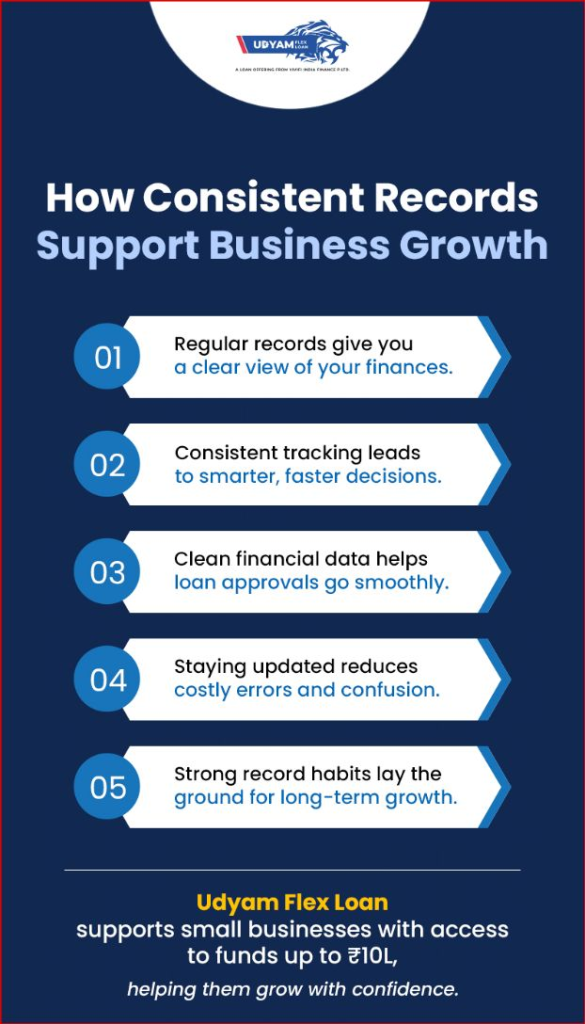
- Consistent financial records help businesses track income and expenses clearly
- They support better planning and more informed decisions
- They improve credibility when applying for MSME business loans
- Lenders use financial records to understand repayment ability
- Clear records make sustainable growth easier to manage
Read on to see how this affects everyday business decisions and future expansion.
How Financial Record Consistency Drives Sustainable Growth
Sustainable growth is not just about earning more. It is about growing without losing control. A business may increase sales and still feel constant financial pressure; this usually happens when growth is moving faster than financial visibility.
When your records are updated regularly, you can:
- See which areas of your business are profitable
- Plan expenses without disrupting operations
- Identify patterns in income and spending
- Make confident decisions about expansion
Without clear records, growth becomes guesswork. With consistency, it becomes structured.
Consistent records also help you manage moments that test the business, such as a delayed payment from a major client, rising raw material costs, a seasonal dip, or an opportunity to take on a larger order. All of these are easier to handle when your financial records are in order.
There is also a credibility factor that many small business owners underestimate. Whether you are dealing with suppliers, accountants, partners, or lenders, consistent records create confidence. They show that the business is being managed with discipline, and that matters especially when you need external support.
How Inconsistent Records Affect MSME Business Loans and Approvals
This is one reason financial record consistency becomes especially important in the context of MSME business loans. Lenders are not only looking at income, but they are also looking at financial behaviour.
A business with clear records benefits from:
- Faster verification and loan approval
- Better assessment of repayment capacity
- Higher credibility as a borrower
- A smoother experience when applying for a business loan online
When applying for a business loan online, digital financial data plays a direct role in evaluation. Online lending systems typically assess bank transactions, income patterns, and expense behaviour. When your records are consistent, this process becomes smoother, reducing back-and-forth and helping you access funds faster.
If your business is growing but financial clarity is holding you back, it might be time to look at both your records and your access to funds.
Udyam Flex Loan supports small businesses with simple and timely access to credit up to ₹10 Lakhs
So you can focus on running your business while keeping your financial planning on track. Because growth works better when it is supported by clarity.
One Practical Shift That Makes Record-Keeping Easier
For many business owners, the problem is not a lack of intent, but a lack of routine. Trying to organize months of records at once is frustrating, and that is usually why the task gets postponed. A better approach is to make record-keeping lighter and more regular.
A few practical habits help:
- Update income and expense entries at a fixed time each week
- Keep business and personal transactions separate
- Track pending payments instead of relying on memory
- Review cash movement before making major spending decisions
- Use a simple spreadsheet or accounting tool consistently, rather than a complex system irregularly
What matters most is continuity. When records are maintained in small, regular steps, they stop feeling like a burden and become useful in real time, instead of only during tax filing or loan applications.
Why Consistency and Business Loans Work Together
Financial records tell your business story. A business loan helps you act on that story. When both are aligned:
- You can plan with confidence
- You can access funds when needed
- You avoid delays caused by missing information
Small businesses often do not face financial difficulty because the business is weak. The issue is usually timing; payments may be delayed, expenses may come earlier than expected, or growth may require funds before incoming cash catches up. This is where a business credit support solution like Udyam Flex Loan becomes relevant, helping MSMEs access funds of up to ₹10L for working capital gaps, operational requirements, or short-term business demands without disrupting momentum.
When that access to funds is backed by consistent financial records, the process becomes much smoother. Clear records improve readiness, strengthen your borrowing profile, and help you use funds more effectively once received.
Conclusion
Financial record consistency may not feel like the most visible part of running a business, but it influences almost every important decision behind the scenes. It shapes how clearly you understand your business, how confidently you plan, and how well you respond to both challenges and opportunities.
For a business that wants to grow stably, consistent records are not optional; they are part of the foundation. They also make a real difference when it comes to accessing external support. If you are considering MSME business loans or a business loan online, having reliable financial records puts you in a stronger position from the start.
With Udyam Flex Loan, businesses can access funds up to ₹10L to manage operational needs and support growth more smoothly. And when that financial support is paired with disciplined financial record-keeping, growth becomes easier to manage in a way that is practical, sustainable, and far more informed. Because sustainable growth is about moving forward with clarity.